Tell the PSC: Protect West Virginia Coal, Jobs, and Ratepayers
West Virginia’s coal industry is facing a major proceeding before the West Virginia Public Service Commission that could have long-term consequences for our state’s coal jobs, coal communities, electric reliability, and utility customers.
FirstEnergy/Mon Power has proposed adding a new 1,200 MW natural gas plant as part of its regulated generation portfolio.
The West Virginia Coal Association has filed testimony questioning the economics of the proposed gas plant, whether the project is truly necessary, and whether it is the least-cost option for Mon Power customers.
At the same time, West Virginia law has made it clear that our existing power plants should be upgraded, improved, and maintained so they can continue serving our state for years to come.
Now the PSC needs to hear from Friends of Coal.
Please take a few minutes today to submit a comment urging the Commission to protect West Virginia coal, West Virginia jobs, reliable baseload power, and affordable electric rates.
Why this matters:
Protect Coal Jobs
A new gas plant could displace thousands of coal miners and power plant workers across West Virginia.
To continue reading, click here to view the full article on CoalZoom.com.
CoalZoom.com - Your Foremost Source for Coal News.
Federal Funding Supports New WV Coal Plant Proposal Paired With Carbon Capture Technology
A proposed new coal-fired power plant in West Virginia is moving forward with federal support, as developers refine plans for a 1.6-gigawatt facility that would pair traditional coal generation with carbon capture technology.
The announcement comes one day after the Trump administration unveiled approximately $700 million in federal investments aimed at strengthening the U.S. coal industry, including support for plant modernization, coal generation and related infrastructure under a broader energy reliability initiative.
Following that Thursday funding announcement, TerraSpark said Friday that the U.S. Department of Energy has selected its proposed TerraSpark Energy Campus for up to $18.5 million in additional federal support to advance front-end engineering and design work, permitting and early technical studies. The project is planned near the existing Mount Storm energy complex in Grant County.
WV Governor Patrick Morrisey, left, speaks to employees of the Blue Creek Coal Processing Plant in Kanawha County.
Photo: Office of Gov. Patrick Morrisey
The project builds on earlier Department of Energy efforts identifying potential new coal generation as part of a broader initiative focused on grid reliability, domestic energy production and meeting rising electricity demand. While new coal-fired power plants have become increasingly rare in the United States, the West Virginia proposal remains among the most advanced under federal review.
If completed, the facility would provide 1.6 gigawatts of baseload electricity while incorporating next-generation carbon capture systems designed to significantly reduce emissions. Developers say the project is intended to meet growing electricity demand driven by manufacturing expansion, artificial intelligence infrastructure and data center development.
To continue reading, click here to view the full article on CoalZoom.com.
CoalZoom.com - Your Foremost Source for Coal News.
Babcock & Wilcox to Support TerraSpark’s Development Efforts for 1.6 GW Coal-fired Power Plant Project in West Virginia
Babcock & Wilcox (B&W) (NYSE: BW) has announced it is collaborating with TerraSpark in support of its planned energy generation project in West Virginia. The project, known as the TerraSpark Energy Campus, will include a 1.6-gigawatt (GW) coal-fired power plant, a multi-industry campus and a Coal Innovation & Training Center for rare earth extraction and advanced materials initiatives. The project has been awarded an $18.5 million grant from the U.S. Department of Energy to support its development.
As part of the intended collaboration, B&W’s anticipated scope for the project would include the design and supply of four 400-megawatt supercritical boilers and a full suite of advanced emissions control equipment. Additionally, Babcock & Wilcox Construction Co., LLC would be expected to provide construction services. B&W will also work closely with Mantel for the project’s carbon capture technology.
“This project aligns with B&W’s continued commitment to serving the U.S. coal fleet, which is a reliable, secure and essential component of the nation’s energy mix,” said Jimmy Morgan, B&W Executive Vice President and Chief Commercial Officer. “We look forward to the opportunity to work with the TerraSpark team as development progresses.”
“Projects like the TerraSpark Energy Campus highlight how coal-based generation can play a critical role in delivering dependable, high-capacity and low-emissions power for emerging demands, including energy-intensive industrial and manufacturing infrastructure, while supporting U.S. energy priorities to ensure reliable and resilient domestic energy resources,” Morgan continued. “Our proven boiler and emissions control technologies are designed to help extend the life, improve performance and enhance the environmental compliance of existing and new coal-fired assets, and we look forward to further demonstrating our leadership in providing advanced, dependable energy solutions – including new, reliable baseload power – to our customers.”
To continue reading, click here to view the full article on CoalZoom.com.
CoalZoom.com - Your Foremost Source for Coal News.
Optimism Abounds at Recent Western U.S. Mining Conference
Two years ago, fewer than 100 people attended a conference held by the Colorado Mining Association, but last month's conference drew nearly 300 attendees, speakers and exhibitors. In more than a dozen interviews conducted by Industrial Info Resources during the event, which ran May 20-22 in Denver, Colorado, there was broad agreement: "It's a great time to be in mining." That could well have been the subtitle for the event, which was titled 2026 Western Mining Summit.
This optimism was the product of various factors: sharp gains in commodity prices; strong demand for minerals; a growing understanding of the importance of supply security for critical minerals and rare earth elements; the extraordinary level of data center project development in the U.S.; and a supportive president in the White House. There was no shortage of reasons to believe that Western mining was back.
Although the CMA conference focused on Western mining, there is a robust pipeline of mining projects under development across the U.S.
According to Industrial Info Resources data, more than 940 capital mining projects, valued at about US$200 billion, are under development across the Western U.S. states. The states with the greatest dollar value of project activity are in the West: Nevada, Arizona, Alaska, Wyoming, Utah and Idaho.
Industrial Info Resources offers more information on these projects in its Global Market Intelligence (GMI) Metals & Minerals Plant and Project databases, where readers can find details--including construction schedules, investment values and necessary equipment--in a detailed list of project reports.
At a recent price of nearly US$4,500 per troy ounce, gold prices have nearly doubled over the last two years. Silver prices have more than doubled since May 2024. At a recent price of about US$6.50 per pound, copper has gone up 50% over the last two years. Although it has fallen from its historic high earlier this year, palladium prices still are up nearly 50% over the last two years, to a current price of about US$1,400 per troy ounce.
To continue reading, click here to view the full article on CoalZoom.com.
CoalZoom.com - Your Foremost Source for Coal News.
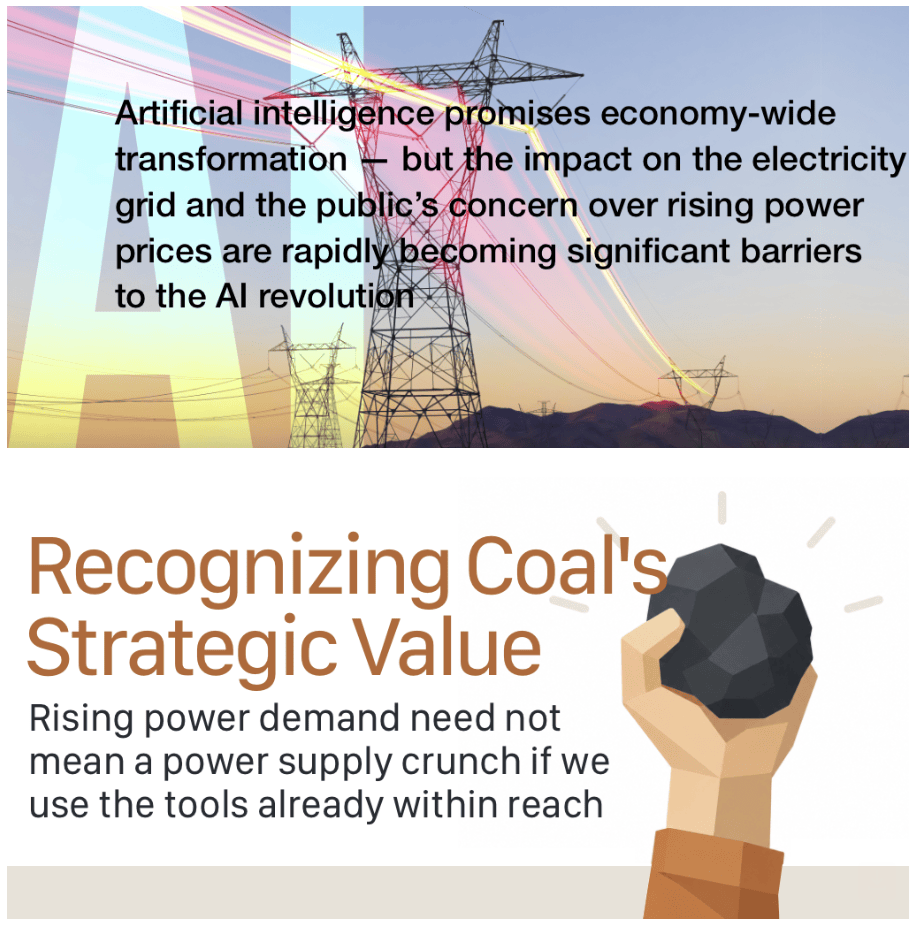
Surging AI Power Demand is Here, Like It or Not
Artificial intelligence promises economy-wide transformation and a pace of innovation we may have never seen before. But the impact of AI on the electricity grid and the public’s concern over data center development and rising power prices are rapidly becoming significant barriers to the AI revolution.
According to the International Energy Agency, global electricity consumption from data centers is expected to more than double by 2030. Here in the United States, utilities and grid operators are forecasting the strongest period of electricity demand growth in decades. The nation’s grid watchdog now expects summer peak demand and winter peak demand to jump by over 225 gigawatts (GW) and 245 GW, respectively, over the next decade—enough electricity to power 150 million homes.
Meeting data center power demand and cushioning the impact on consumers requires more reliable and affordable power. And the need is no longer in the distance—it’s here now.
Reliability Concerns Are Delaying Coal Retirements
The challenge posed by surging demand and ballooning electricity prices – up 40% since 2020 – is already reshaping the conversation around coal.
As electricity demand accelerates and reliability concerns mount, utilities and grid operators are increasingly reconsidering coal plant closures. In fact, the amount of coal capacity closed in 2025 fell to a 15-year low according to the U.S. Energy Information Administration.
To continue reading, click here to view the full article on CoalZoom.com.
CoalZoom.com - Your Foremost Source for Coal News.